
Introduction: A Global Challenge of Accountability
There are over one billion firearms in circulation worldwide. Military forces hold approximately 133 million small arms, and police and law enforcement agencies hold 23 million.
Despite these staggering numbers, the systems used to manage, secure, and account for weapons have changed very little since World War II.
Across military, police, corrections, and private security organizations, manual record-keeping—via spreadsheets, clipboards, and paper forms—remains the norm. These outdated processes lead to errors, inefficiency, and security vulnerabilities.
Weapon tracking has therefore become a critical operational and security priority.
More on Weapon Tracking…
Weapon tracking is the process of monitoring, recording, and controlling the movement and custody of weapons, gear, and ammunition through modern technology.
A Weapon Tracking System (WTS) digitally identifies, tracks, and secures every item—whether stored, issued, or returned. The system integrates hardware and software to manage the entire lifecycle of armory operations.
Core Components of a Weapon Tracking System
- Software Platform – Database-driven system to manage all assets and users.
- Tracking Technologies – Implementation through Barcodes & QR codes, RFID, Bluetooth, GSM, and GPS tags.
- Security Hardware – Biometric authentication, access control, and alarms.
- Labels and Tags – Serialized identifiers for weapons, gear, and ammo.
- Implementation & Support – Installation, configuration, training, and maintenance.
Why Traditional Armory Management Fails
Across most military, police, and security organizations, the processes used to issue and return weapons have changed little in decades. Inside countless armories, Excel spreadsheets, handwritten ledgers, and paper forms still serve as the backbone of record-keeping. These legacy systems were adequate in an era when the scale of operations was smaller and the threats were simpler — but today, they represent one of the greatest operational risks to national and organizational security.
Error-Prone and Inconsistent
Manual tracking of weapon issues, returns, and inventory inevitably causes human error.
A single wrong digit in a serial number, an unrecorded return, or an incorrectly filed document can create discrepancies that ripple through the entire chain of custody.
Unlike database systems that validate and cross-check entries automatically, spreadsheets and paper forms rely entirely on operator discipline and manual verification.
Over time, these errors accumulate, resulting in data fragmentation, duplicate records, and inaccurate inventories.
The result is uncertainty — and in an armory, uncertainty can mean loss of accountability for lethal assets.

Time-Consuming and Operationally Inefficient
Manual armory operations are slow by design.
Each issue or return transaction requires personnel to:
- Identify the individual,
- Verify their authorization,
- Locate the correct weapon and serial number,
- Record the data by hand or into a spreadsheet, and
- Obtain physical signatures.
When multiplied across hundreds or thousands of daily transactions, these steps consume valuable time and manpower.
Routine inventories — which should take minutes with modern systems — can take hours or even days to complete manually.
This inefficiency not only reduces operational readiness but also strains resources that teams could deploy elsewhere.
Insecure and Vulnerable to Misuse
Manual systems provide no real-time visibility into where a weapon is, who has it, or when it was last moved.
Paper logs can be misplaced or falsified, and spreadsheets stored on local computers offer no protection against unauthorized access or manipulation.
If a weapon is taken without authorization or misplaced, the event may go unnoticed for hours or even days.
By the time the discrepancy is detected, tracing accountability becomes nearly impossible.
Such vulnerabilities expose organizations to theft, black-market diversion, and reputational damage — issues that modern weapon tracking technology is specifically designed to eliminate.
Non-Compliant and Audit-Deficient
Defense and law-enforcement organizations operate under strict compliance frameworks that demand verifiable chain-of-custody documentation for every weapon, piece of gear, and round of ammunition.
Paper and spreadsheet systems cannot meet these standards.
Auditors must cross-reference multiple sources — often incomplete or outdated — to reconcile data.
This increases the likelihood of compliance failures, potential legal exposure, and even loss of certification for armory operations.
In a world where transparency and accountability are critical, manual systems simply fail to provide the audit trail required by modern governance and security mandates.
Why Only a Few Have Modernized
Despite the evident shortcomings, less than 5% of global defense and security organizations have adopted advanced weapon tracking systems.
This slow adoption often stems from institutional inertia, budget constraints, or misconceptions that technology integration is overly complex.
Yet those who have transitioned — including the U.S. Department of State, U.S. Air Force, Saudi Arabia Royal Guard, and the Federal Bureau of Investigation (FBI) — showcase the transformative impact of modernization.
Their implementations demonstrate:
- Instant accountability of every weapon and user.
- Automated, paperless issue and return workflows.
- Rapid, error-free inventories powered by RFID and barcode scanning.
- Integrated security controls that prevent unauthorized removals.
These agencies have proven that digital weapon tracking is not a luxury — it is a mission-critical tool that strengthens national security, operational efficiency, and public trust.
How a Weapon Tracking System Works
A modern Armory Management Weapon Tracking System completely automates the lifecycle of weapons, gear, and ammunition — from procurement and registration, through issue and return, to final retirement or decommissioning.
The system replaces guesswork and paperwork with data-driven control, recording, validating, and tracing every firearm, magazine, and transfer of custody in real time.
Let’s break down how this works in real-world armory environments.
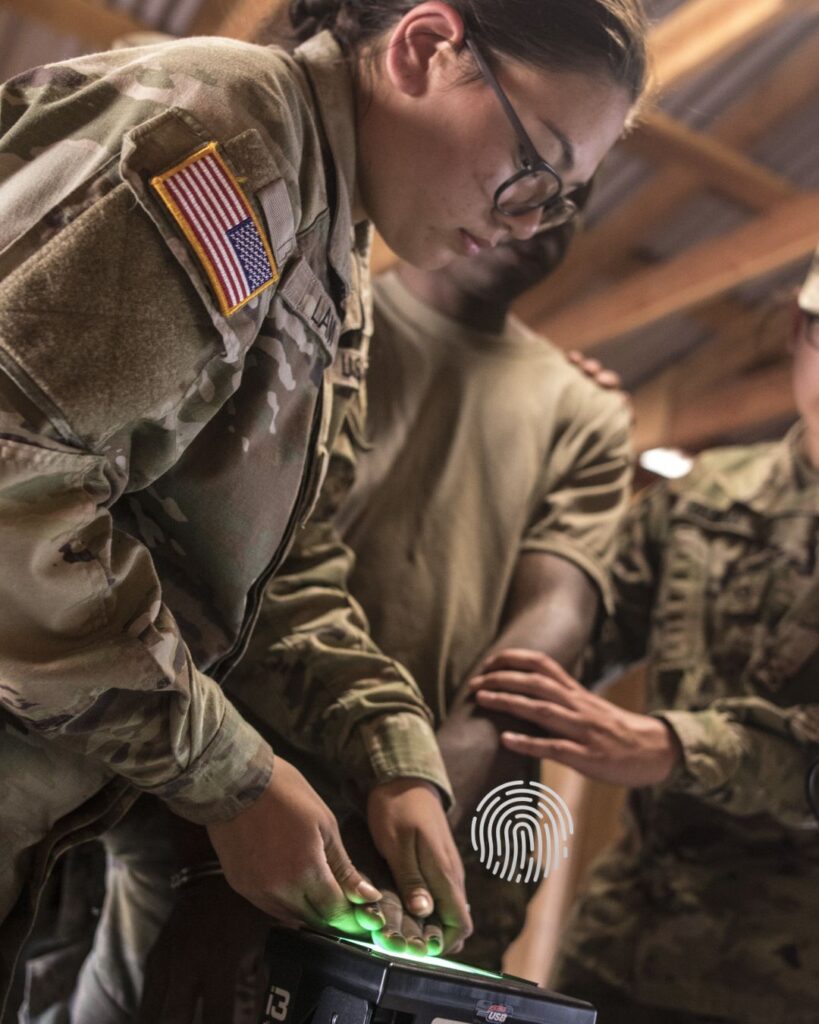
1. Personnel Authentication — The Foundation of Accountability
The system must first authenticate the individual requesting any weapon before issuing it. This is the first and most important layer of control in modern armory operations.
Real-world example:
In a police department armory, when an officer reports for duty, they must present their ID card or CAC (Common Access Card) at the weapon issue counter. The system automatically:
- Scans the officer’s ID and cross-references it with the internal personnel database.
- Confirms the officer’s authorization status (e.g., “ARM” or “DO NOT ARM”).
- Validates their certifications, firearm qualification dates, and duty assignment.
The system locks the transaction and alerts the armorer or supervisor if it detects that the officer’s weapon certification has expired or shows a disciplinary status (such as “DO NOT ARM”).
Military bases often use fingerprint or facial recognition authentication instead of cards, providing a biometric match before releasing any weapon.
This authentication step ensures that only authorized, qualified, and active personnel can receive weapons or ammunition — creating a strong compliance backbone for every armory operation.
2. Issue, Assignment & Check-Out — Digitally Controlled Weapon Distribution
Once a person is verified and cleared, the system automatically pulls up their assigned loadout — the specific weapons, gear, and ammo allocated to their role, unit, or post.
For example, a Special Forces officer may be assigned:
- One M4 carbine (Serial #NGX-21834)
- One 9mm sidearm (Serial #PXT-34021)
- Three loaded magazines
- Night vision goggles and ballistic vest
This loadout instantly appears on the armorer’s dashboard or tablet interface, ensuring precision and consistency in issue.
Operational flow example:
- The armorer scans each weapon’s RFID tag or barcode.
- The system verifies the match between the serial number and the officer’s record.
- Any deviation (such as issuing the wrong weapon serial number) triggers an on-screen alert.
- Once confirmed, the officer signs digitally on a tablet or signature pad, or scans their fingerprint to confirm transfer of custody.
A timestamped audit trail is automatically generated — recording:
- The officer’s name and ID
- The weapon and gear serial numbers
- The issuing armorer
- Date, time, and location of the transaction
No one can alter, delete, or overwrite this digital trail, creating a permanent record that satisfies even the most stringent audit or investigation requirements.
Real-life use case:
The U.S. Air Force and Saudi Arabia Royal Guard both use similar check-out workflows, enabling rapid weapon deployment for hundreds of personnel during shift changes while maintaining 100% accountability.

3. Return & Check-In — Fast, Accurate, and Automated
At the end of a shift, duty, or deployment, personnel return their weapons, gear, and ammo for inspection and storage.
With a modern weapon tracking system, this process is automated and nearly instantaneous.
How it works in practice:
- The officer places the weapon and gear at the return window.
- RFID antennas integrated into the counter automatically detect all tagged items as they pass through.
- The system cross-checks the items against the officer’s issue record — marking each as “Returned” in real time.
If any item is missing, an alert appears immediately — allowing the armorer to flag it before the officer leaves the premises.
For smaller agencies or correctional facilities, handheld Bluetooth or USB RFID scanners can be used to perform the same function.
Once all items are returned and verified, the officer signs digitally, and the system logs the complete transaction, including:
- Date and time of return
- Armorer receiving the items
- Items verified and condition status
- Any discrepancies noted (e.g., damage, missing magazines, or maintenance needs)
Example:
In the Bermuda Police Service, implementing automated weapon returns cut their end-of-shift reconciliation time from over 90 minutes to under 10 minutes — with zero discrepancies.
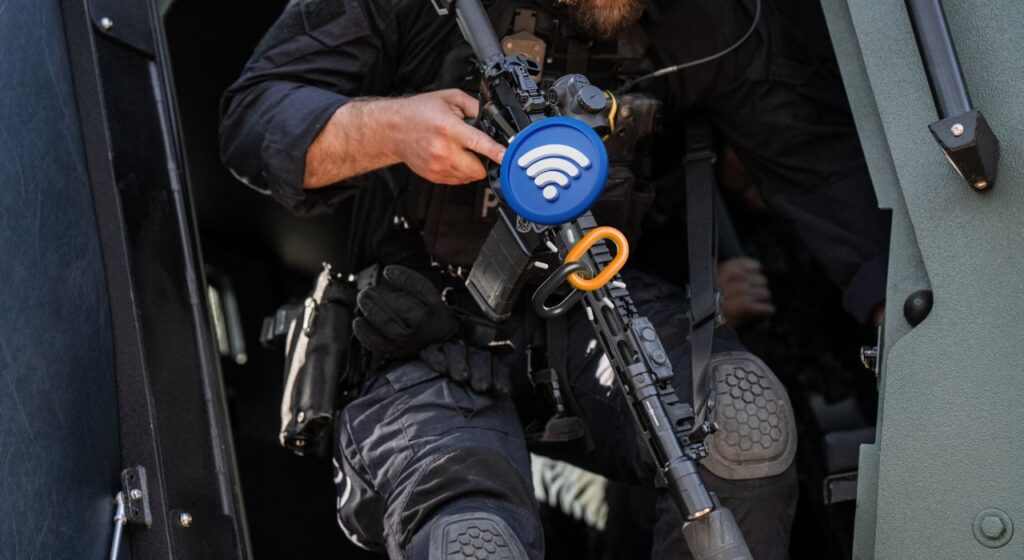
4. Automated Inventory & Audit — Real-Time Accountability
Manual inventories have long been a pain point in armory operations.
Traditionally, staff would spend hours or days reconciling paper lists with physical counts — an inefficient process prone to human error.
With modern RFID and mobile scanning technology, this task has been reduced to minutes.
Here’s how it works:
- A mobile RFID scanner connected to a tablet or smart device is used to sweep through the armory.
- The scanner detects all RFID-tagged weapons, gear, and ammo within a 25–40 foot range — simultaneously.
- The software automatically compares scanned items with database records.
The results appear instantly in color-coded status:
Real-time application:
In one U.S. Air National Guard base, daily RFID scans replaced manual audits that once took three hours — now completed in under 15 minutes with 100% data accuracy.
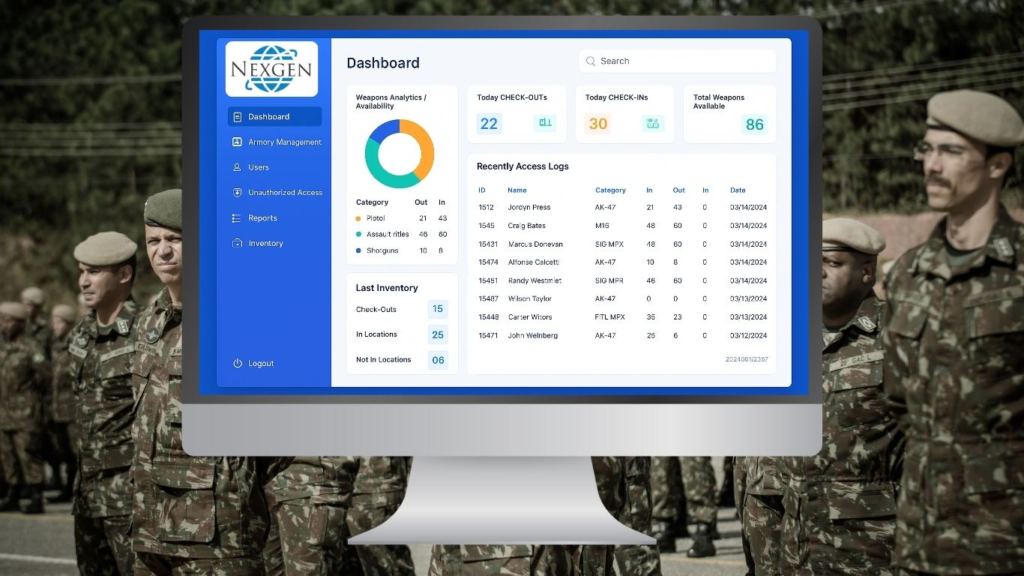
Commanders can log into a dashboard at any time and see a live inventory report — weapon by weapon, rack by rack.
Bringing It All Together
From personnel authentication to final audit, every stage of weapon management becomes digital, traceable, and secure.
This automation means:
- Faster operations: Weapon issue and return time reduced by up to 90%.
- Improved security: Unauthorized removals are instantly detected.
- Better compliance: Every transfer of custody is auditable.
- Higher efficiency: Inventories are completed in minutes, not hours.
Weapon tracking technology turns armory management from a reactive, manual process into a real-time command and control system — ensuring that every asset, every transaction, and every person in the chain of custody is accountable and visible.
Weapon Tracking Technologies Explained
Combining multiple identification, tracking, and security technologies, weapon tracking systems ensure complete accountability and real-time visibility of every weapon, piece of gear, and round of ammunition within an organization.
Depending on the size, threat profile, and operational requirements of the armory, different technologies can be used individually or in hybrid configurations — offering the right balance of cost, performance, and automation.
1. Barcode Tracking — The First Step Toward Digital Transformation
Barcodes remain the most cost-effective and reliable method for identifying and tracking weapons, accessories, and ammunition. They serve as the entry point for organizations transitioning from manual recordkeeping to automated, database-driven armory management.
How It Works
Each weapon or item is assigned a unique barcode label that corresponds to its serial number and database record. During issue, return, or inventory:
- The barcode is scanned using a handheld or fixed USB/Bluetooth scanner.
- The scan automatically populates the weapon’s data in the system — no manual entry required.
- The software validates the match between the scanned ID and the assigned record.
Types of Barcodes
- 1D Barcodes (Linear Codes): Represent a single unique number — ideal for weapons or serialized equipment such as pistols and rifles.
- 2D Barcodes (QR/DataMatrix Codes): Encode more information in a smaller space — suitable for small components, optics, or magazines.
Real-World Example
A regional police department may begin by labeling all firearms and critical gear with industrial-grade barcodes.
Armorers use Bluetooth scanners to instantly record issues and returns, replacing handwritten logs.
This simple upgrade reduces data-entry errors, accelerates daily operations, and establishes a digital audit trail — paving the way for more advanced RFID-based systems in the future.
2. RFID (Radio Frequency Identification) — Real-Time Armory Visibility
RFID technology represents the next leap in weapon tracking, providing real-time, passive monitoring of every weapon and item within the armory — without manual scanning.
How It Works
Each weapon, gear item, or ammunition case is fitted with a small RFID tag (active or passive).
When these tagged items come within range of RFID antennas or readers, the system automatically:
- Detects and identifies them simultaneously (up to 100+ items at once).
- Updates their location and status in real time.
- Triggers alerts if any item leaves a defined area without authorization.
Operational Benefits
- Simultaneous Detection: RFID readers can scan all tagged items within a 25–75 ft radius — perfect for full-room sweeps.
- Passive Automation: No manual scanning needed during issue or return — the system recognizes items automatically.
- Security Alerts: RFID-enabled doorways or checkpoints trigger visual and audible alarms if unauthorized removal occurs.
Deployment Scenarios
- Military Armories: Long-arm rifles and magazines are fitted with passive RFID tags embedded inside weapon grips or attached discreetly to stocks.
- Police Departments: RFID portals at issue windows detect every weapon passing through — automatically logging issue or return without user input.
- National Agencies: RFID audits can be conducted using mobile handheld scanners, allowing quick validation of expected vs. actual weapon presence.
3. Bluetooth, GSM, and GPS Tracking — Intelligent, Field-Level Weapon Monitoring
For high-risk tactical operations, basic inventory control isn’t enough. Weapons need to be tracked beyond the armory walls, even during active missions or off-site deployments.
This is where Bluetooth, GSM, and GPS-enabled tracking technologies redefine weapon accountability.
How It Works
Weapons are equipped with advanced IoT-enabled tags that combine multiple sensors:
- Bluetooth (BLE): Communicates with nearby personnel tags or vehicles to confirm proximity.
- GSM/GPS: Sends live geolocation data via cellular or satellite networks.
- Accelerometers: Detect “shots fired” events or sudden weapon movement.
Operational Capabilities
- Live Location Tracking: Command centers can see the real-time GPS position of every active weapon on a digital map.
- Geo-Fencing: Virtual boundaries can be set; if a weapon exits a designated zone (e.g., police compound or base perimeter), the system sends automatic alerts.
- Separation Alerts: If a weapon moves beyond a set distance from its assigned officer, a “Weapon Separated” warning is triggered.
- Incident Detection: Built-in accelerometers detect gunfire or excessive movement, automatically logging the event and alerting nearby units.

Field Applications
- Private Security Firms: GPS-linked tracking helps recover weapons stolen during vehicle ambushes.
- Police Tactical Units: Bluetooth-enabled tags pair each weapon with an officer’s RFID ID badge, ensuring instant accountability during deployment.
- Military Bases in Conflict Zones: GSM/GPS tags provide visibility of weapons leaving secured compounds — a critical measure against black-market leakage.
Although these tags cost between $50–$125 each, the security value far outweighs the expense for agencies operating in volatile or high-threat environments.
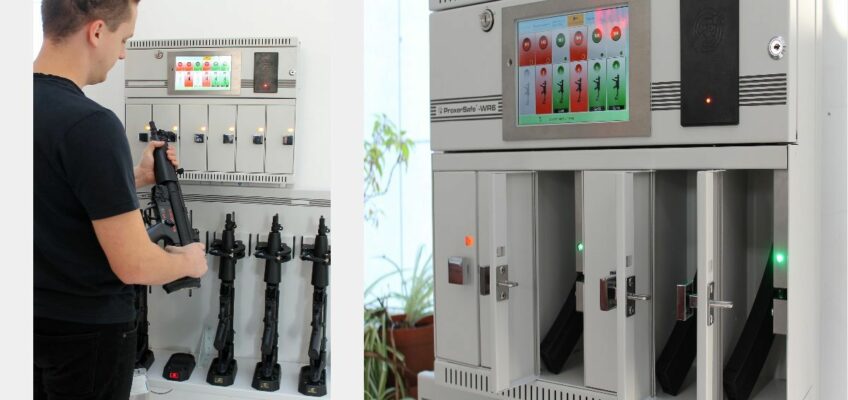
4. Smart Weapon Storage Systems — The Next Frontier in Armory Automation
Weapon tracking extends beyond identification — it integrates with Smart Armory Infrastructure to create a secure, self-managing ecosystem.
Core Features
- Automated Issue & Return: Officers can authenticate themselves via biometrics (fingerprint or face scan) or ID card to retrieve assigned weapons, even without an armorer physically present.
- RFID-Integrated Racks and Lockers: Each compartment automatically detects the presence or absence of a weapon or magazine.
- Real-Time Status Monitoring: The central dashboard displays which weapons are currently issued, returned, or overdue.
- Built-in Charging Stations: For smart tags and GPS trackers, ensuring operational readiness.
Use Case Example
In a rapid-response police unit, each officer uses a biometric scanner on the locker to access their assigned sidearm.
The RFID sensors detect when the weapon is removed or returned, while the system logs the event and transmits it to the central database.
If an officer forgets to return a weapon, or if a locker is opened without authentication, an automatic alert is triggered both on-site and in the control center.
Such smart systems transform armories from passive storage spaces into intelligent security assets — capable of managing weapons autonomously, 24/7.
5. Security Integration in Weapon Tracking — Total Control from Entry to Exit
Weapon tracking is not merely about locating assets; it’s about ensuring that no weapon moves unseen or unaccounted for.
Modern systems integrate directly with physical security and surveillance infrastructure to enforce layered protection at every access point.
Key Security Integrations
a. Access Control Devices
- Limit and log entry into armories and weapon warehouses.
- Authentication can be done via PIN, ID card, fingerprint, iris, or facial recognition.
- Entry logs are automatically linked to the weapon tracking database, creating a unified access and activity trail.
b. RFID Security Doorways
- Equipped with antennas and sensors that detect any RFID-tagged weapon approaching an exit.
- If an unauthorized weapon is detected, alarms, lights, and camera feeds activate instantly.
- The system records the event — including time, weapon ID, and the individual attempting removal.
c. Video Surveillance Integration
- High-definition cameras capture video or still images of every issue, return, or alarm event.
- Video clips are automatically linked to the corresponding transaction record, creating visual chain-of-custody documentation.
d. Alarm & Light Systems
- Serve as real-time deterrents and alert mechanisms during attempted unauthorized removals or breaches.
- Can be configured for local sirens or remote alerts to security command centers.
Result: A Fully Traceable Ecosystem
Every interaction — whether staff check out a weapon, open a door, or move a firearm across a threshold — is automatically:
- Authenticated
- Recorded
- Audited
- Secured
This layered integration ensures that weapon tracking is not an isolated function, but a comprehensive security infrastructure — protecting assets, personnel, and public trust.
Weapon tracking systems today are intelligent, interconnected ecosystems.
They combine barcode simplicity, RFID automation, GPS precision, and biometric access control into a single framework that ensures 100% accountability and zero tolerance for error.
Whether it’s a nationwide military command center, a state police department, or a private security agency, modern weapon tracking provides the same promise:
Every weapon known. Every movement tracked. Every transfer secured.
Benefits of Implementing Weapon Tracking Systems
| Category | Benefit |
|---|---|
| Efficiency | Issue/Return time reduced by up to 90% |
| Accuracy | Automated identification eliminates human error |
| Compliance | Meets audit, legal, and chain-of-custody requirements |
| Security | Prevents unauthorized weapon removals |
| Accountability | Complete traceability of every transaction |
| Integration | Syncs with ERP, procurement, and HR systems |
Weapon tracking enhances not just operational control but also institutional confidence, assuring both command authorities and the public that weapons are managed responsibly.
Implementing a Weapon Tracking System
Deploying a Weapon Tracking System (WTS) is not just a technology purchase — it is a structured transformation of how an organization manages, secures, and accounts for its weapons, gear, and ammunition.
The process involves careful evaluation, planning, and execution to ensure that the new system integrates seamlessly with existing workflows and infrastructure.
Below is a detailed look at how leading military, police, and security organizations successfully plan and implement modern armory management and weapon tracking systems.
1. Assessment — Identifying Operational Gaps
The first stage is to analyze current armory operations and identify deficiencies in existing processes.
This includes assessing how weapons are:
- Issued and returned,
- Logged and audited,
- Secured within storage facilities, and
- Tracked between armories, depots, or field deployments.
Typical problems discovered during this phase include:
- Manual data entry errors in spreadsheets or logbooks.
- Delays during issue and return cycles.
- Lack of visibility when weapons leave a facility.
- Missing or duplicate serial numbers.
- Difficulty reconciling physical counts with records during audits.
Example:
A national police force might find that it takes over three hours to reconcile one armory’s inventory due to manual paper-based systems. The assessment concludes that automated RFID scanning and a centralized database could reduce that time to under 20 minutes — while eliminating human error.
The goal of this phase is to document the pain points and define quantifiable improvement goals such as faster issue times, reduced audit duration, or improved weapon accountability.
2. Vendor Evaluation — Partnering with Proven Experts
Once the organization understands its needs, it must evaluate vendors with proven global expertise in weapon tracking.
The best vendors are those who:
- Have deployed systems for government, defense, and security agencies.
- Provide commercial off-the-shelf (COTS) software that can be rapidly configured (not custom-built from scratch).
- Offer hardware and integration support — including RFID, barcode, and biometric devices.
- Provide long-term service and maintenance guarantees.
Example:
An organization might shortlist vendors based on prior projects with clients such as the U.S. Department of State, Saudi Arabia Royal Guard, or Bermuda Police Service, as these deployments reflect a track record of success in secure, regulated environments.
Vendor evaluation should also include:
- Software demonstration sessions.
- Case study reviews.
- Technical specification comparison.
- Reference checks with other users.
Selecting the right vendor ensures not just system capability but also reliability, scalability, and long-term support.
3. Scope Definition — Mapping Weapons, Gear, and Ammo
This phase focuses on defining exactly what needs to be tracked.
Each armory, warehouse, or depot compiles a detailed inventory of all relevant asset types:
- Lethal and non-lethal weapons (sidearms, rifles, Tasers, batons).
- Weapon-dependent gear (sights, optics, silencers, holsters).
- Ammunition (boxes, magazines, cases).
- Protective gear (vests, shields, helmets).
- Personnel and authorized users.
Each category is assigned a unique template in the weapon tracking software, specifying the fields needed (serial number, model, status, location, maintenance schedule, etc.).
Outcome:
By the end of scope definition, the organization has a clear digital blueprint for its operational ecosystem — defining how data will flow, who will manage it, and what technologies will be used to track each category.
4. Technology Selection — Barcode, RFID, or Hybrid Tracking
Choosing the right tracking technology depends on budget, operational environment, and security needs.
- Barcode Systems: Best for small armories or organizations transitioning from manual systems. Cost-effective, simple to deploy, and easy to maintain.
- RFID Systems: Ideal for large-scale military and police armories requiring real-time tracking, automated issue/return, and fast audits.
- Hybrid Systems: Combine both — barcode labels for low-value or bulk items, RFID tags for serialized or sensitive weapons.
Example:
A correctional services department may choose a hybrid setup — barcoding handcuffs, shields, and OC sprays, while RFID-tagging firearms and magazines. This ensures a balance of accuracy and cost efficiency.
During this phase, the vendor conducts pilot testing to determine read ranges, tag performance, and environmental durability to finalize the system configuration.
5. Infrastructure Planning — Laying the Operational Foundation
Weapon tracking technology must integrate seamlessly with the armory’s physical and IT infrastructure.
This stage involves defining all hardware, network, and workspace requirements.
Typical planning elements include:
- Number of tracking workstations inside the armory.
- Issue/return windows equipped with RFID antennas.
- Doorway security checkpoints with alarms and cameras.
- Authentication devices (fingerprint scanners, ID readers, signature pads).
- Networking and power requirements, including Ethernet drops or Wi-Fi for scanners.
- Server configuration — on-premises or cloud-based, depending on security policy.
Real-world example:
A national guard facility might install:
- Two fixed RFID stations at the issue counter.
- One mobile scanning cart for field audits.
- RFID-equipped doorways at all exit points.
- Biometric access control to restrict unauthorized entry.
This infrastructure ensures the system is ready to capture every transaction in real time once deployed.
6. Deployment — Implementation, Testing, and Training
After design and configuration, the system is installed and tested in a live operational environment.
Deployment includes:
- Installation of hardware (RFID readers, scanners, access devices).
- Software setup and integration with internal databases.
- Tagging and labeling of all weapons and gear.
- Initial data import — serial numbers, user profiles, and inventory data.
- Pilot runs to verify performance and accuracy.
Once verified, full-scale training sessions are conducted for:
- Armorers and warehouse staff (day-to-day operations).
- Supervisors and commanders (reporting and dashboard analytics).
- IT staff (system management and troubleshooting).
Training ensures that every user understands not only how to use the system, but also how it enhances accountability, compliance, and operational efficiency.
7. Ongoing Support and Maintenance — Sustaining Long-Term Performance
Organizations must maintain weapon tracking as a mission-critical system to ensure it never fails.
Leading vendors provide 24×7 global support, including:
- Software and database updates to meet evolving standards (Microsoft, Oracle, etc.).
- Hardware replacement or repair under warranty.
- Remote or onsite troubleshooting and configuration support.
- Periodic user training and performance audits.
Some organizations also opt for Service Level Agreements (SLAs) guaranteeing:
- 99.9% system uptime,
- Immediate response to security events, and
- Regular backup and recovery testing.
Example:
A defense logistics division with multiple depots across a region may use centralized cloud monitoring — allowing the vendor to push updates remotely and monitor hardware health without disrupting operations.
End-to-End Integration: Turn-Key Weapon Tracking Solutions
Top-tier vendors deliver complete turn-key solutions, covering:
- Software configuration and customization
- Tag provisioning (barcode and RFID)
- IT hardware and networking
- Security device integration (access control, alarms, cameras)
- Onsite installation and training
- Continuous remote support
This approach allows organizations to transition from manual systems to fully automated armory management within weeks — achieving real-time accountability, reduced audit times, and complete operational confidence.
Why Weapon Tracking Is Now Mission-Critical
Weapon tracking is not optional—it is an operational necessity.
In an era of heightened threats, insider risks, and public scrutiny, organizations must:
- Demonstrate instant accountability for every firearm.
- Maintain real-time visibility into weapons movement.
- Prevent loss, theft, or misuse through intelligent automation.
As global defense and security operations evolve, digitized armory management will define the next era of responsible weapon governance.
The Future of Weapon Tracking
While the core database-driven architecture of weapon tracking systems will remain stable, the hardware and tag technologies will continue to evolve—becoming smaller, faster, and more affordable.
RFID, Bluetooth, and GPS integration will blend with emerging IoT standards, further improving performance and situational awareness.
But the biggest driver of advancement will not be technology—it will be leadership commitment to accountability and modernization.
Organizations that adopt weapon tracking today will set the global standard for security, compliance, and operational excellence.